

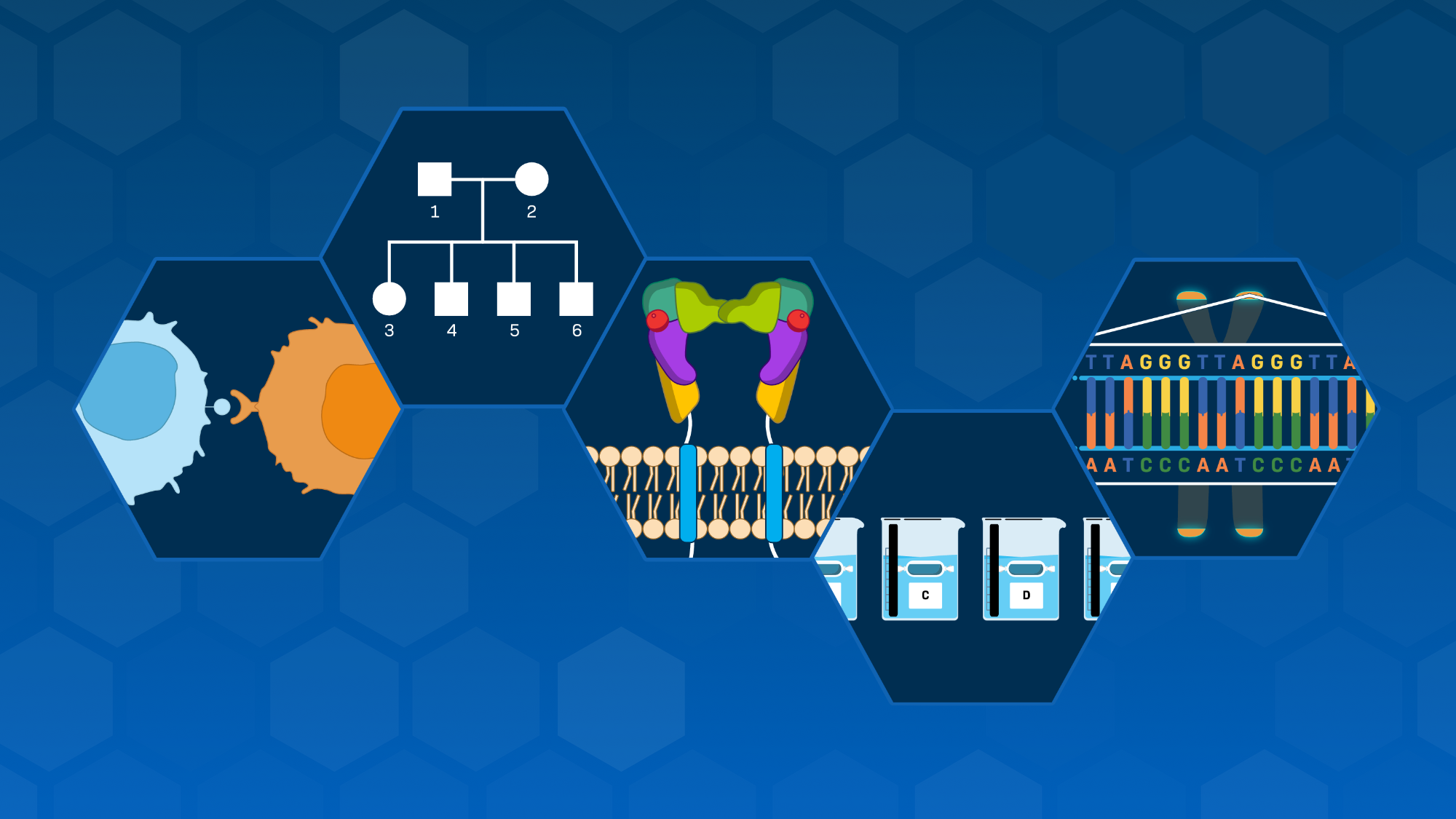
Some AP® Biology topics are hard to teach not because the content is obscure, but because they ask students to juggle several ideas in their heads at once. These ideas might be, for example, a cell signaling cascade with a dozen moving parts, a statistical test layered on top of a lab result, or a process like meiosis that sits at the crossroads of cell division, inheritance, and gene expression.
This summer, LabXchange ran AP® Biology Deep Dives, a three-part professional learning series pairing our subject matter experts with biology educators to dig into exactly these topics: what makes them difficult, where students get stuck, and how to teach through it.
Curious what came out of each session? Here's a look back at all three sessions, plus a few strategies for tackling tough topics that showed up again and again.
"We teach how something works, then we break it—and students predict what happens. That's really how research works: we pick something out, break it, and see what happens."
—Sven Heinrich, PhD, LabXchange subject matter expert
Sven Heinrich, a lead content creator at LabXchange with a background in cell biology research at Harvard and MIT, opened the series with a talk on cell signaling. An abstract topic (you can't watch a receptor change shape) that's often taught through diagrams dense enough to intimidate even working scientists, cell signaling can trip students up. His suggestion for educators: use a "mutation" as a teaching tool. Show students how the pathway works, then show them what happens when a single piece breaks—a receptor that can't bind its ligand, or one that's stuck permanently "on." Teaching the failure mode, he argued, is often what makes the working process click.
"At its core, [meiosis] sits at the heart of three other interconnected topics—inheritance, cell division, and gene expression."
— Kathryn Gardner, PhD, LabXchange subject matter expert
Kathryn Gardner, a biochemist and geneticist who spent a decade teaching undergraduate biology before joining LabXchange, tackled meiosis. Her approach to teaching meiosis is to treat it as a foundation to build rather than a set of facts to memorize. She gives students repeated, low-stakes chances to practice distinguishing chromosome structures, tracking changes across phases, and predicting outcomes before asking them to weave all three together.
"Ideally, students should be looking at data every day in the AP® Biology classroom."
— Paul Schwein, PhD, LabXchange subject matter expert
Paul Schwein, who leads LabXchange's Data Science-Driven Science Education project, closed out the series with a session on data analysis. Rather than treating data literacy as its own unit, his approach is to distribute it throughout the year, threading statistics and visualization into whatever content students are already learning so that the skills get reinforced continuously instead of crammed into one block. Adding in a targeted data science question to each lab can go a long way in getting students used to dealing with the topic.
Want to see these strategies in action? Check out a few of the LabXchange resources our subject matter experts picked as their favorites for teaching AP® Biology topics:
Or, visit our full collection of AP® Biology related resources here!
We're exploring expanding these sessions into a structured professional development series covering the full AP® Biology curriculum, and we'd love your input on how we shape it. If you have a few minutes, please share your thoughts via this short form.
AP® is a trademark registered by the College Board, which is not affiliated with, and does not endorse, this content.

.svg)

.svg)


